Manifest (2018)
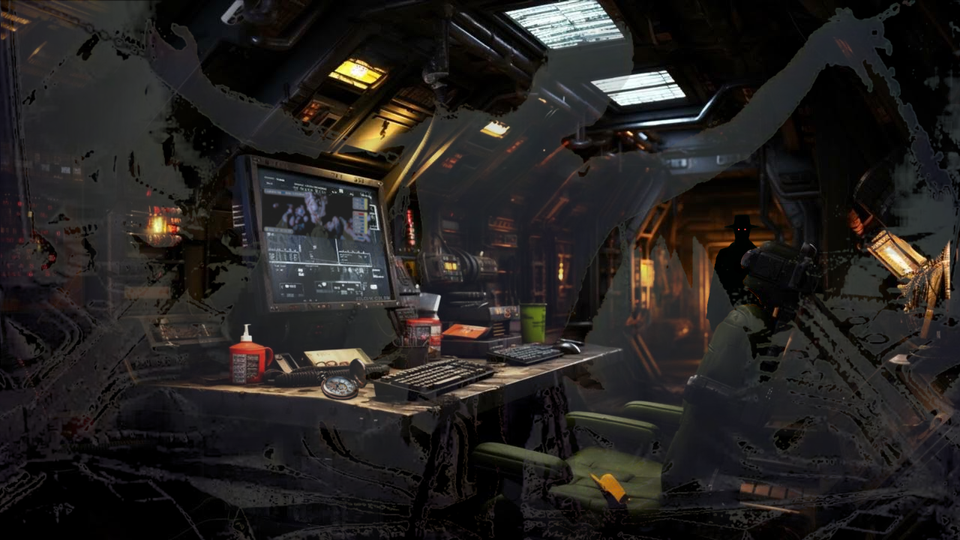
Captain Ray Dorsett always expected the worst, so his surprises were generally pleasant ones. This last week had been the exception to the rule. He had a hundred different contingency plans for each and every problem under the sun, but now the sun was nothing more than a single star among billions and the problems he faced were ones not even the most prophetic could have anticipated. His decades-dead father standing unblinking in the corner of Dorsett’s cabin for the past three nights, for instance.
---
Two weeks ago Dorsett had been sitting in the crew mess, marveling at the relative smoothness of their journey so far. The UNES Proxy had left Earth’s orbit nearly a year ago, accelerating towards the edge of the solar system with few major issues. A couple of social incidents -to be expected from spending so long in close quarters- and a few minor breakdowns; nothing that he or his highly competent officers couldn’t sort out. Remarkably uneventful for such an epic inaugural voyage.
Dorsett had always found value in adversity; throughout his life he’d seen struggle as the best way to learn and grow. Dorsett credited his competency and persistence to the hard times, not the easy ones. He was the ideal candidate to lead a mission where cataclysmic failure lurked around every corner, where any decision could be one of life or death.
Dorsett commanded a crew of 23 others aboard the 400 meter long interstellar vessel. Three officers and one noncom were under his command, along with six scientists, a collection of twelve privates first class, and one corporal to round out crew responsibilities. They were a joint research and exploration team, en route to Proxima Centauri: an exoplanet within the habitable zone of Alpha Centauri, the closest star system to our own.
Earth’s decline had been long predicted and well documented. Technological advancements for preserving the biosphere had fallen far behind the continual growth of hedonism and consumption, and the strain it had put on Earth was proving too great. So humanity finally stopped looking toward the stars, and started reaching for them.
Renowned German physicist Pascale Seeger had brought forth a beacon of hope; building from the thousands of combined research hours into antimatter propulsion, she created an engine system capable of near lightspeed travel, making the final frontier a feasible one at last. The Seeger Drive was capable of accelerating up to 95% of the speed of light, turning a journey many generations in length to one that could be measured in decades, or even years; Alpha Centauri being the ideal candidate at 4.2 light years away. Pascale was one of the scientists onboard, after insisting she be present to monitor the drive’s inaugural trip and assist with any problems that arose from it.
The resulting voyage had been organized hastily, relative to the enormity of the undertaking. Astro-spectrometers had all but proven the presence of liquid water, but not much else was known about the exoplanet. Proposals to send unmanned, Seeger Drive propelled probes were discarded. Even with Humanity’s new found speed, initial data would not be received for 13 years at minimum - time Humanity was quickly running out of.
Instead, the United Nations had built two crewed ships, the UNES Proxy and the UNES Eden. The Proxy was to be sent out to gather a full assessment of Proxima Centauri. It would either designate and prep a colony site, or continue on to the next likely candidate. The Eden was a leviathan, built to hold millions of people transported in cryosleep and keep the active crew members alive indefinitely. Eden would follow behind the research vessel by several years, bringing some lucky members of humanity to their new home. The eight year delay would allow Proxy to transmit data back to the colony ship just as Eden was nearing full acceleration, dictating if it should stay its course or plot one to the next viable star system. It wasn’t a foolproof plan, but it beat total extinction.
Dorsett and his crew would spend a year accelerating as they travelled toward the edge of the solar system, just under a year and a half travelling at their max speed, and one last year decelerating as they reached their destination. His First Officer Alex Navarro had laughed when he realized the theory of special relativity meant his ex-wife back on Earth would age twice as fast as him for the duration of the journey.
“She always said she’d piss on my grave,” he had said, “but now I got the jump on her in more ways than one. Thank you Einstein!”
The Proxy was reaching full acceleration near the far edge of the Kuiper belt when everything began to go sideways.
---
One of the cook staff reported that the dry food storage had been infested with hundreds or thousands of cockroaches, but when Dorsett’s Master Sergeant Vincent Caravella investigated he found no evidence of insects.
“The damndest thing,” the hulking man said, reporting back to Dorsett, “no roaches, no droppings. Wasn’t even damage to the packaging. Hell, how’d they’ve got on in the first place? Ain’t exactly a Spanish Galleon, only rats are in the lab. And no, they didn't bring any roaches to experiment on, I asked Dr. Almstedt.”
Caravella shifted his bulk uncomfortably, but maintained eye contact with Dorsett. “Hernandez saw it though, he ain’t lying…”
“Tell him to report to Pettersson. Don’t tell her I said this, but cabin fever is the main reason we brought along a psychologist.”
Caravella frowned. “Hernandez didn’t seem out of it, sir,” he rubbed his clean shaven jaw, “been solid. Never had any trouble with him.”
The Master Sergeant’s duties revolved around supervising the 12 PFCs and single corporal, acting as interim command for their day to day operations. Caravella had spent most of his past year in the 13 men’s company. Dorsett interacted with them, but there would always be a divide between officers and enlisted.
“He’s hallucinating. That’s enough trouble for me.”
However, Hernandez wasn’t the only one.
Hours later Dorsett’s intercom beeped; Navarro calling him from the helm.
“Uh, Sir? We’ve got a bit of an odd problem up here. We’re having some, uh, technical glitches on some of the displays.”
“You notified Cho?”
“Yeah, she’s up here with me. She’s looking at it but said to call you.”
Dorsett heard the Chief Engineer swearing in confusion.
“What in the ever living fu-”
“The displays,” Navarro said into the intercom, “some of them, well, some of them are playing cartoons...”
The sentence hung in the air.
“And sitcoms…”
A minute later Dorsett was standing in front of the door to the helm, waiting for it to cycle. The computer confirmed neither side was in hard vacuum and slid open. Alex and Chief Engineer Samantha Cho both turned to look at him as he stepped over the threshold, their expressions puzzled and frustrated.
“It stopped. Just now, everything switched back to normal when the door cycled,” Navarro said, “You just missed it.”
Dorsett looked at Cho. “What exactly, was ‘It’?”
“I really do not have a clue, sir, but I can dig through the logs and metadata, see what was going on in the back end,” Cho looked back at the screens, which had reverted to displaying navigational data. “If this were anywhere else, on a base, in an office, I would tell you it was an IT prank. But I really do not think Schwartz or Holiday are that stupid. No one else on board would know how, as far as I know.”
Dorsett told her to speak with them and look through the data feed. As he turned to leave he heard Navarro commenting that he had recognized the cartoons.
“My kids would watch these stupid shows every damn day.”
---
Every piece of data that goes through the ships system is automatically logged, analyzed by one of the ships computers, and backed up. Human error was understandable and expected, so the computer was constantly watching in case something was missed. It stored the compiled feed for human review when necessary, either onboard, or after this phase of their mission had been completed.
Theoretically this was one of the problems the computer was supposed to log and report, but Cho quickly realized it had done no such thing. Not only was there no error log, but when she had gone through the various screens’ playback, not a single one showed what her, Alex, and the two helmsmen on duty had all seen.
According to the ship’s computer, it had never happened.
---
Over the next two days the number of incidents increased dramatically. Bulkhead doors refused to open, stating depressurization on one or both sides despite crew members breathing easily in both affected sections of ship. One of the scientists onboard, geologist Rashid Najafi, went to see Pettersson on his own initiative after finding letters written by hand from his daughter, chronicling food shortages in their hometown and the death of his grandson. Multiple crew members reported failing or flickering lights in various parts of the ship, anomalies that didn’t appear when Caravella combed through the security footage. Navarro spent an hour mesmerized, watching a full episode of his kids’ favourite sitcom on a display that should have been showing star charts. Within days nearly every member of the crew had experienced something bizarre and unexplainable.
The phenomenon escalated as they approached the far edge of the Kuiper Belt and the end of the solar system. Caravella discovered five of the PFCs blindingly drunk in the mess, playing poker when they should have been on duty. Dorsett reviewed the security footage himself, saw Caravella berating an empty room and the five men stationed at their respective posts.
That night Dorsett woke to see his father standing in the corner of his cabin, steel eyed and frowning at his estranged son. Edward Dorsett had been dead for over 30 years.
Eliana Pettersson was working overtime. Her door had become a revolving one, with Dorsett meeting her daily, and a long backup of psych evals to be done in response to the crew’s hallucinations.
“Under normal circumstances stress rarely creates such vivid hallucinations,” she said to Dorsett as he stood behind her desk reviewing her notes, “and the crew’s medical history underwent an extensive audit during the selection process. None of the medications the crew have been prescribed have visual hallucinations as a side effect. Even if they did, it would only explain the symptoms for less than a quarter of us. On paper we’re the um… the photo of good health.”
“Picture of good health.” Dorsett said quietly. Swedes started learning English in primary school, but there were ticks here and there. Pettersson had asked him to correct her idioms early on.
“Yes, thank you,” she panned through her notes, “before the incidents began, reports of distress were minimal. The crew has been coping well with our isolation for the most part. A few of them were having nightmares, and Dr. Najafi has been concerned about the welfare for his family back home. Some paranoia and fear is normal, considering the circumstances.
“Anxiety and stress have risen dramatically in the last 5 days, but that is likely a response to the crew’s experiences, not the cause of them.
“What’s more concerning is the shared experiences. Group hallucinations are incredibly rare, although our circumstances are exactly the type to give rise to them. Folie à plusieurs, ‘Madness of Several’ it can be called. Social isolation, prolonged time in close quarters. Some oddities are to be expected. The severity however, are not. And frankly Captain, I do not have an adequate explanation.
“At this point I feel it would be unwise to prescribe any antipsychotic medication. Without knowing the root cause, any drug therapy would be ineffective at best,” she raised her eyebrow, “and at worst could exacerbate the symptoms.”
Dorsett nodded. “Understood. Tell me what you need.”
---
Hours later Dorsett was sitting in his cabin, hoping for a brief respite. He perched on the end of his bunk, holding his grandfather's pocket watch. It was heavier than he remembered. Dorsett opened it and was dismayed to see the face had been cracked. Over a hundred years old, it was the only memento he had of his family. The only meaningful connection to his past besides DNA and hemoglobin. Some tiny detail about holding it now in his hands was nagging him, but he couldn’t place it. He pushed the thought aside as his door intercom buzzed.
“Hey it’s Cho.”
No rest for the wicked.
Cho was shaking slightly as she entered, her eyes red-rimmed from lack of sleep and emotional exhaustion. She asked to show Dorsett something on his console.
“I feel like I have gone crazy; the logs have changed.”
Cho pulled up the ships metadata and security footage. Dorsett saw Cho and Navarro on the bridge looking at cartoons and sitcoms in confusion.
“The last time I looked at this recording, the screens were showing what they should have been, not what Alex and I saw,” she slumped in the chair, “it makes no sense.”
She pulled up footage of the crew mess. “You saw this, right? Caravella berating an empty room?”
The recording showed Caravella grabbing one of the PFCs by the collar and yanking him to his feet. Four others looked on in apprehension, clearly intoxicated. The scene played out exactly as Vincent had described.
“Not a fake, either.” Cho said.
Dorsett felt the panic building in his chest. He clamped it down.
“Tell the science crew I want to meet with them in three hours. We need to figure out what exactly is going on, and what we can do.”
“Three hours?”
“I haven’t slept in the last 48.”
“Fair enough, set your alarm,” Cho said, motioning towards the antique watch in Dorsett’s hand.
As she left, Dorsett remembered he’d given the watch to his brother over a year ago, before he’d left earth. The face hadn’t been cracked. It was heavy and cold in his hand.
Dorsett lay down and shut his eyes. When he opened them Edward was back in the corner, watching.
---
Dorsett woke to a scream echoing down the hall, his door wide open. He was in the hallway instantly, heading toward the source of the noise.
Najafi’s door was also open. The small man kneeled on the floor in a pool of blood, holding a beautiful young woman in his arms. Her wrists had been violently slashed.
“Aafreeda!” He rocked the pale dead woman back and forth, mumbling in Arabic.
“Rashid! This isn’t happening! None of this is real!” Dorsett moved to untangle the doctor from the corpse, but Rashid shrunk away, clutching the body to his chest.
“My daughter is dead. How can she be dead? She was to be on the Eden.” His eyes were wild. He made no indication he’d heard Dorsett. Reverting to Arabic, his voice reached a fevered pitch. He raised his hands to the ceiling and a knife appeared in them.
Dorsett lunged, but Rashid was faster. He didn’t hesitate as he drove the six inch blade into his own eye socket, slumping to the floor and convulsing. The blood spread, pooling on Dorsett’s shoes as he stood in shock. Someone screamed from the hallway behind him.
---
Minutes later Dorsett had gathered the remaining scientists. He fought the shock by reverting to old habits; any action was better than none. He was more comfortable thinking on his feet. Dorsett knew the harshest experiences were the best teachers; class was in session.
The scientists onboard had been selected for their abilities to conduct an accurate and expedient planetary survey. They came from a wide variety of fields and disciplines, the best and brightest earth had to offer. However the current situation had them all out of their depth. That hadn’t stopped Dr. Seeger and the others from hypothesizing and investigating.
Lilyana Almstedt, the expedition’s biologist, spoke up. “I think I speak for all of us when I say the nature of these experiences are daunting and difficult to explain. With respect to Dr. Najafi, the woman in his room is the first tangible piece of evidence that I can investigate.
“She isn’t on the crew manifest, clearly not a stowaway. She appears to be Rashid’s daughter. I’d like to run an autopsy.”
“Get it done ASAP, the medbay is yours.”
She hurried out. The biochemist Jiro Ito raised his hand.
“I took the liberty of running the bloodwork for the crew. Nothing appeared to be abnormal,” he shrugged, “toxicology was clean.”
“I think it is worth considering that Dr. Najafi was experiencing paranoia regarding the state of his family back on earth,” Dr. Pettersson said, “he found handwritten letters detailing events on earth that didn’t transpire until after we’d left. Something to add to the list of ‘physically impossible’.
“His paranoia and fate seem to be correlated.”
“I’ve experienced something similar,” said Dorsett, “found a watch I left on earth.” He exhaled deeply, “and I’ve been seeing my father.”
Pascale Seeger’s face was furrowed in concentration. “Let us compile the evidence we have. It began with individual hallucinations, rooted in individual fears and paranoia, which became shared visions. Security footage confirmed they were hallucinations, except that in the past 24 hours these visions have begun to manifest physically. I looked at our telemetry data, and this occurred at the same time we reached full acceleration. The same time we left the solar system entirely.
“These manifestations have even occurred retroactively, going by the current security data. Bloodwork and psychological analysis has not explained it, nor are does there appear to be any major data corruption or purposeful manipulation in the ship’s computer. This is beyond the scope of our professional or personal experience, and it has crossed the line from improbable to impossible.
“So we must think outside the box. Outside of what is possible.”
The room was silent for a moment. Dorsett raised an eyebrow.
“Outside of what is possible is your domain Dr. Seeger, we wouldn’t be here if that wasn’t the case. Give me something I can work with.”
“Be careful what you wish for, Captain,” Pascale said softly, “the ideas that have refused to leave my head in the past day are hard to be believed.”
“Try me.”
She cocked her head. “I was not always a physicist. My first degree was actually one in philosophy, with a heavy focus on the nature of consciousness. To this day, consciousness is a riddle we have yet to solve. We have many theories but few concrete facts.
“Are you familiar with the theory of panpsychism Captain?”
Dorsett shook his head.
“It is the theory that consciousness is an intrinsic property of all matter, that over time matter combines to increase in complexity and better express that consciousness.”
“What, you’re saying rocks can think?”
“Not exactly, or at least not in a way that a human would consider ‘thinking’. But in extreme layman’s terms, yes. Panpsychism aligns with quantum theory, and provides an explanation of why consciousness exists at all. To look at it in a more spiritual way, it is the belief that consciousness creates form. That consciousness is what the universe itself is built from.
“What if matter contained the consciousness that creates the reality we perceive and experience?
“What would happen if the only matter within millions of kilometers contained the chaotic, uncontrollable consciousness expressed by the human mind? If that chaotic consciousness alone was tasked with creating reality? Without the stability of consciousness contained in matter unwarped by the human psyche?
“To put it simply, Captain, what if the task of maintaining reality as we know it rested solely on our personal mental capacities? Reality would change on a whim, in relation to our thoughts.”
“I’m afraid I don’t fully understand what you’re getting at Pascale.”
“I am saying that, perhaps, the sheer amount of matter in the solar system -and the consciousness intrinsic within it- influences and creates the physical laws that govern the reality we experience. Now that we have passed beyond its influence… now that we are alone in the void, reality is being governed by our consciousness alone, and is breaking down due to the uncontrollable nature of the human mind.
“Rashid’s daughter, your pocket watch, the altered security footage. It is our consciousness that is manifesting these things.
“Or at least, that is my ‘outside the box’ theory.”
“Jesus Christ.”
Dr. Ito raised an open hand, his eyes closed and face scrunched. For a moment his hand remained empty. Dorsett blinked; a rose had appeared clutched in Jiro’s fist.
Dorsett whistled, “holy shit.”
Ito was equally shocked. “All I did was picture it.”
Impossible, thought Dorsett. As soon as the thought had crossed his mind the rose crumbled into dust.
The intercom buzzed, it was Navarro.
“Dorsett, another problem on the readouts here. According to this we’re still accelerating. We should have maxed out yesterday, but we’re up to 97% of light speed. And gaining.”
Seeger’s eyes went wide. “This is my fault. I have been worrying about the potential ramifications of reaching light speed, if reality is indeed breaking down. At this point it would appear that thought alone is enough to break the laws of physics.”
“Seems okay to me, the quicker we get back to reality the better,” Dorsett said, “maybe we should all consider going under sedation until we begin decelerating.”
“Captain, the unconscious mind is still an active one, I don’t think that will solve our problems,” Seeger said, “and the faster we go, the farther we get, the less the rules of physics apply. I am scared to think of what might happen if we were to reach the speed of light. Currently, it might be possible.”
“Great, so what do we do? Read Newtonian physics textbooks to each other aloud?
“98%” said Navarro through the intercom.
Almstedt entered, flushed and out of breath.
“The woman. On the surface she matches Rashid’s daughter. Fingerprints and facial features are identical to the records on file. But when I cut her open,” her eyes were wide, “... it was just meat. No organs, no nervous system, no bones. Just flesh. I’ve never seen anything like it.”
Pascale looked towards the ceiling. “I suppose that’s what happens when a geologist manifests a biological entity.”
“99% Captain.”
“Dorsett, we must not reach light speed!”
“Navarro, can you decelerate at all?”
“Nothing’s responding, sir.”
Pascale gritted her teeth. “At light speed, our perception of time will shift. I can’t say for certain, but it may only seem like an instant.”
“Sounds like the best case scenario.”
Those were the last words out of Dorsett’s mouth before reality broke.
He was outside of himself, literally. Dorsett could see the entirety of the ship, inside and out, stretching across light years. Time and space distorted, the ship and crew occupying every inch of their journey simultaneously. A million Dorsetts wandered the halls, ate in the mess, rested in his bunk while watched by a million ghostly fathers.
Rashid impaled himself and collapsed, time and time again.
Caravella wrestled with a billion drunken PFCs. Some versions of him were overwhelmed, brutally murdered by the men under his command. Some versions overcame the drunk recruits, smashing them aside, hands bloody. One Caravella sat down and joined them at their game of poker. Several floated in the void, cold and dead.
Hernandez was ripped apart by a billion bloodthirsty cockroaches.
Navarro cried as he watched his children, catatonic in front of a million cartoons. His ex wife squatted in one of the halls, pissing on his corpse.
Cho fought fires in the engine room. She suffocated in a depressurized corridor. Holiday grabbed her by the neck and together they tumbled into the ship’s core.
Seeger sat crossed legged, eyes closed, deep in meditation or prayer. Unlike the rest of the crew, every instance of her occupied the same place. She was surrounded by a bright light that emanated from her chest. Somehow, in her small bubble, reality maintained a modicum of consistency.
Dorsett was outside of time. He saw these things happen in unison, separated by eons. Eternity stretched but passed in an instant. He felt his consciousness expand to the edges of physical reality and beyond. His mind mingled with Pettersson’s, with Rashid’s, with Caravella’s and Navarro’s. It melded with every member of his crew, each individual represented an infinite number of times. He shared their fears, hopes, sorrows, and strengths. One by one he felt their consciousness fade, returning to the void they alone occupied.
Dorsett held onto his grandfather’s watch, straining his infinite consciousness to focus on its minute details. He filled his mind with memories of his life, his experiences, and personality. Struggle had always made him stronger. He refused to fade.
He understood the horrors before him were temporary. He saw beyond the veil of reality, embracing the pain and suffering, bathing in it. Relishing it.
The pain showed him every secret corner of the universe.
Infinity collapsed, many became one. Dorsett’s experience returned to a single point, his physical body was once again his own.
“99%” read the computer data; the ship was decelerating. It had reached Alpha Centauri.
---
Dorsett was alone. He walked the length of the ship, finding the corpses of his crew littered throughout. Perhaps not entirely alone, he could hear sobs echoing throughout the ship. It sounded like Dr. Seeger.
Dorsett smiled, his mind still lost in the cosmic mysteries that had been laid out before him. He could never explain the things he had learned, but he felt compelled to teach regardless. Eden would be reaching the edge of the solar system soon, waiting for word that Alpha Centauri was the answer to humanity’s prayers. They could be taught, if they had his strength.
Dorsett pulled Navarro’s corpse from the command chair and sat himself in the drying blood that saturated it. He keyed in the command that would give Eden the green light to continue its journey beyond the solar system.
He laughed, thinking about the surprises that awaited them.