The Road to Abraham (2018)
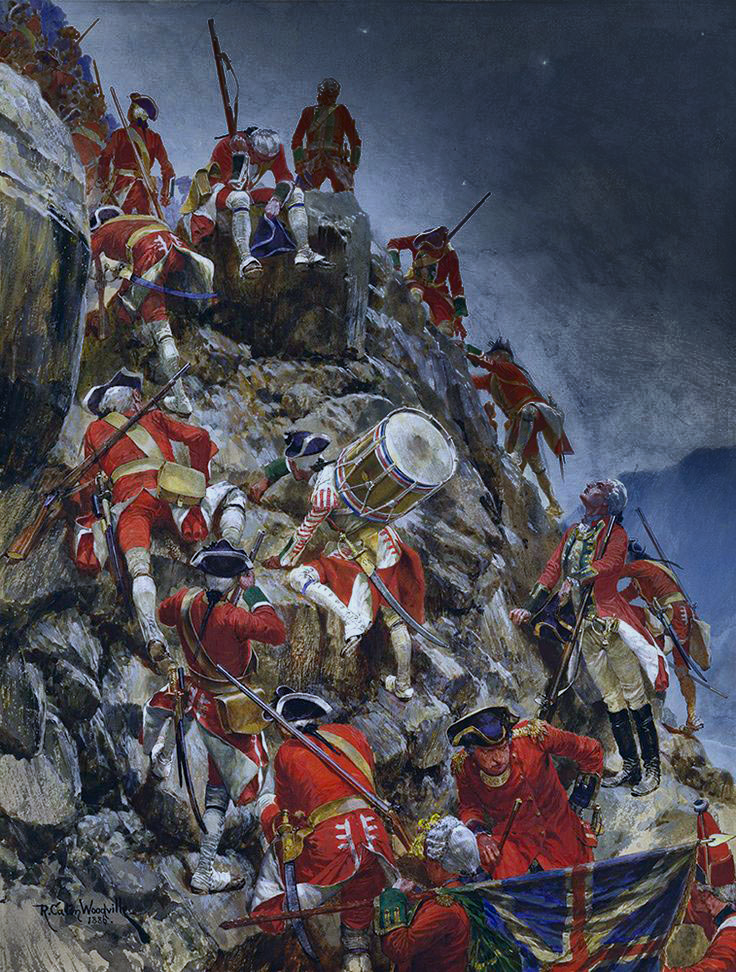
“The bastard would rather die before dawn than sail home in disgrace,” Sheppard spat, casting his gaze up the steep cliff into the dark, “Wolfe’s sickness has spread to his mind, surely. He'll take us all with him to hell.”
“Calm, Serjeant.” Colonel Howe said, his voice low and bemused. “I have no plans for us to visit hell today, but if your voice carries as far as your stench I shan’t have much say in the matter.” He leaned in close so Sheppard could see him wink. “We have the distinct pleasure of being the first to stroll up the hill this morning, let’s not disturb the French’s beauty sleep just yet.”
“Bloody insane officers, we’re buggered if any of the frogs go fer a piss.”
The Serjeant’s tone was light; many officers would reprimand their subordinates for such tactless candor, but Howe gave a long leash to the scarred and heavily muscled 40-something year old when it came to the way he conducted himself.
The two were close friends, Sheppard spoke curtly and crudely but was the most reliable enlisted man Howe had come across in over a decade of service. The Serjeant had been under his command for almost 10 years, since Howe was a fresh faced 19 year old lieutenant of the 20th Regiment of Foot. He’d pulled some strings to bring him along to the 58th, which Howe now commanded. Both men felt an incredible debt to one another, a bond of trust and comradery that was unusual between commissioned officers and non.
Sheppard had saved Howe’s life in the Austrian Succession war, driving off three armoured hussars who had knocked 20 year old Howe from his horse in the heat of battle. Howe had returned the favour more than once; he had always been the type to lead from the front line, which had given him ample opportunity to prove his personal martial abilities to the rough and tumble Serjeant.
The river pebbles shifted under Howe’s boots as he surveyed the dark shadows of men clambering onto the shore. He’d intended for them to land at a small dirt road that wove up the bluff, but there was no sign of any path cutting up through the low shrubs and scattered rocks. It appeared they’d landed too far up the river in the early morning blackness. Not Howe’s fault, but he’d take responsibility nonetheless. He had a job to do this morning, and would have to quickly think of a new way to accomplish it. He looked up the steep bank, an idea that Sheppard would think was as crazy as any of General Wolfe’s, starting to percolate in the back of his head.
The wind off the water was crisp, almost bitterly cold. The beginning of a Fall chill exacerbated by the early hour. Howe figured he had three or so hours until dawn broke, and much to do in the meantime. His mind momentarily drifted back to the warm cup of tea he’d drained hours ago, across the river at the British encampment. He shook his head, bringing his thoughts back to the cold shore; there would be time for those comforts once the day’s work was complete.
Howe directed his Captains to get the men organized into rank and file while he considered the next move. Wolfe had ordered him to take his men straight up the road, clearing the small camp of French militia head on. This would allow the bulk of Wolfe’s 4500 men to follow unchallenged and establish themselves on the plains above, behind the French’s main defenses, forcing General Montcalm - the leader of the French here in Quebec City - to meet them on the field instead of continuing to cower behind the battered fortress walls.
Some would call it a daring, cunning, surprise attack. Others - such as Serjeant Sheppard - would call it suicidal. Once it began they would be fully committed, there was no possibility for retreat; the small British army would be surrounded by French troops, steep cliffs and cold water. Whether it would be remembered as a stroke of brilliance or pure folly was largely on Howe’s shoulders, tasked as he was with the first crucial steps.
And I have the pleasure of accomplishing it without even a goat path Howe thought, teeth gritted. He would be earning his pay this morning. However, any watch they’ve placed will be focused on the road. A climb could save me grief in the long run.
Howe could not in good conscious order his battalion of men up the treacherous cliff face in the predawn darkness. Long ago he’d decided never to send his men to a task he himself would not undertake, especially one as dangerous as this. It had nothing to do with the glory of leading the charge, and everything to do with the responsibility he felt to each and every one of the men under his command. Howe took no pride in the fact he knew the name of every man in the 58th Regiment of Foot, they were more than his subordinates, they were his charges, caste. His family.
If the encampment at the top noticed their ascent the assault would be over before it began; the noise of 200 men climbing such a steep cliff would quickly negate the surprise gained from the cover of darkness, and the men he considered closer than blood would pay the price. Fighting mid-climb would be impossible, so he’d have to bring the fight to the French, perched on top of the windswept cliffs.
Howe had surveyed the camp that watched the road from across the river hours before, as the sun was setting. It was small - less than a hundred men - and the colours they flew showed them to be militia, not the hardened French regulars who occupied the main fort. The men with him on the beach were career soldiers, a mix of Highlanders and the 58th, each one worth four of the hodgepodge troops who slept unaware more than fifty meters above them.
Howe grinned in the dark, he wouldn’t need his whole battalion.
“Sheppard,” he beckoned the hulking Serjeant over, “find me some men willing and able to make the climb. The rest will stay down here and wait for us to take the road.”
Sheppard nodded and began to walk down the beach towards a group of kilted infantrymen.
“No coercion Serjeant,” Howe called softly after him, “I demand genuine enthusiasm and desire to spill a bit of French blood before breakfast.”
Sheppard chuckled and nodded. Enthusiasm for gutting some frogs was easy, it was finding lazy bastards willing to haul themselves up a cliff in the pitch black that would be tricky.
Twenty three men - including Sheppard - lined up in front of Howe, nervously adjusting their gear.
“Rucksacks down, bayonets fixed.” Howe said, hand resting on the pommel of his sabre. “We shall take their camp with surprise and steel; if we wake the fort none of us will be alive to see dawn.”
Sheppard walked the line, glowering at the volunteers.
“If any one of yous let off a shot I will toss you over the bloody cliff meself. Mark me now.”
They laughed, their teeth bared somewhere between grin and grimace. One man unprimed his musket to prevent any accidental misfire and the rest followed suit. They slung the heavy weapons over their shoulders and Howe led them to the base of the cliff.
Howe looked up into the darkness. From where he stood the full height of the climb was hard to determine, obscured by the night, but he knew it was nearly 200 feet to the top. He was resolved to be the first up, not because of pride, but because he would never ask his men to do something he could not accomplish himself. That attitude had led him to success and quick advancement, and fostered a deep respect from his men that gave them the desire to push beyond their own perceived limits. They wouldn’t follow just anyone up a climb such as this, but they’d follow Howe through hell’s maw itself, because they knew he’d be the one leading the charge.
Wolfe will be remembered as a genius or a lunatic, or both, Howe thought as his hands gripped a shrub, pulling himself upward, and with this stunt I imagine I’ll share his fate.
The dirt and rocks were cold under his hands. He’d removed his gloves for better grip, but as the feeling began to fade from his fingertips he wondered if it had been a poor decision. The cliff was covered in low shrubs and small trees that scrapped his hands and face as he pulled himself upwards. By the time he’d made it 30 feet, the rush of the river and howl of wind had covered the low murmur that came from the few hundred men directly below him on the beach. The slope was a mix of loose shale that slipped under his feet, clumped earth, and sheer rock. He jammed his boots into the damp soil to gain purchase, hoping not to slide back into the men that followed closely behind him.
Howe’s muscles were aching but the cliff still rose high above him, fading into the night. Sheppard was close, the strong man’s breath harsh and ragged as he pulled his huge frame up towards the unseen firelight of the French lookout. His boot knocked a small rock free, tumbling down and knocking off the hat of one of the men climbing below, who swore, his voice barely audible over the roar of the wind. If the man’s head had been raised another inch he could easily be tumbling back towards the beach far below, Howe gritted his teeth at the thought.
Howe gripped a sapling that clung to the cliff, taking a moment to catch his breath. He was cocooned in darkness, the river invisible below and the plains hidden high above. He could see nothing but cliff and void, they could have been ten thousand feet above the ground, distance was meaningless in the pitch black. He was struck by intense vertigo, the river and sky momentarily switching places, causing his head to spin. He pulled himself closer to the vertical rock face, hugging the small tree and hoping Sheppard wouldn’t notice his momentary disorientation. He grabbed his own ear and pulled sharply, the pain bringing his head back onto his shoulders. Howe dug his hands into the shrubs above his head and continued the ascent.
His arms screamed in protest as the length of the climb took its toll. Sweat was dripping down his face in torrents, his hands would have been slick if not for the thick coating of dirt and sap that had accumulated on them. He didn’t dare look up, it wouldn’t change the distance left. He had no idea if there was ten more feet or another hundred. The only way to know for sure was to reach the top.
The dirt under his feet shifted, and he began to slide backwards. He tried to catch himself, but felt his back being dragged outwards by gravity, his throat clenched in panic as he began to fall. A huge hand wrenched his collar, and pulled him back towards the hill. His face smacked into the cold rock and he tasted blood as a tooth nicked his lower lip.
“Can’t expect me to kill all the frogs meself, Sir.” Sheppard whispered as he pressed Howe to the hillside, waiting for him to regain his balance and grip. “I ain’t doin’ an officer’s job for Serjeant’s pay.”
Howe might have chuckled, had his throat not been firmly clenched shut. He motioned that he was good to continue, and Sheppard let go of his jacket collar. Howe felt the blood rush through his chest as his heart hammered. He made a mental note to dig out the fine brandy he’d been saving back at camp and gift it to Sheppard when the day’s work was complete. He wouldn’t mind a sip this moment to calm his nerves, but now was not the time for drinks or daydreams.
They continued to climb, time faded and lost meaning as they dug their fingers through the cold dirt and cutting thorns. Howe’s strength was fading, but he continued to lead the climb through pure force of will, ignoring the loss of feeling in his extremities and how his legs were beginning to shake. He climbed until his strength was gone, and then kept climbing. There would be no rest for the wicked today, and none for the saints either.
Howe’s arms were about to give out completely when his hand finally grasped the top edge of the cliff, and he hauled himself over. He collapsed on the wet grass and sucked in breath, his embarrassment at being in such an undignified position outweighed by the gratitude of being back on solid, flat ground. One by one the other men pulled themselves over the precipice, exhausted but exuberant at what they’d just accomplished.
Two minutes later, all of the men had pulled themselves up, crouching along the cliffside. They found themselves 100 feet away from the collection of tents and barricades that comprised the lookout camp, the fires smoldering and mostly unoccupied. Shadows moved on the far side of the tents, sentries watching the road for any incursion, outlandish as such an attack would be.
None of the sentries faced Howe and his men, they’d lucked their way to the perfect spot behind the lookouts. The twenty four men took a few long moments to catch their breath, then Howe pulled his sabre from its sheath and motioned for the men to form ranks. They hefted their muskets and began to stalk towards the tents. The moon slid out from behind the low layer of clouds, illuminating the grim expression on Howe’s face.
He inhaled deeply, then spoke quietly but clearly.
“Now!”
They broke into a shambling run, clearing the last 10 meters to the tents quickly. A sleepy French officer looked up from the fire as Howe cleared one of the low canvass mounds, smashing the hilt of his sabre into the surprised mustached face. The officer tried to yell, but choked on the blood pouring from his nose, resulting in a muted gurgle. Howe’s momentum carried him overtop the stunned man, his knee connecting with the Frenchman’s forehead, knocking him into the guttering fire.
Men stirred in the tents, climbing out in confusion only to be met with bared steel. Some tried to lash out and were quickly put down, others immediately dropped to their knees and raised their hands in submission, overwhelmed by the early morning violence.
Sheppard and five other men rushed to the pickets that lined the road. The militiamen standing watch had barely registered the attack, focused as they were in the opposite direction. The wooden pickets provided no cover for the French as they were attacked from the rear, and the watchmen were given no chance to surrender.
Sheppard’s bayonet pierced through thick blue wool and into the ribcage beneath. It stuck on the bone and was ripped from his hands as the dying man crumpled to the ground. One of the French - no older than 17 - dropped his musket and hurdled over the picket, fleeing into the night. Sheppard spat, ashamed one had gotten away, but unwilling to chase him into the dark.
The sounds of violence faded as quickly as they started. It hadn’t taken 10 minutes to overwhelm the unaware French. Howe glanced around the small camp, counting 15 or 20 bodies, injured or dead, with another 20 or more prisoners his men had lined up on their knees and bound. Not a single Redcoat had been incapacitated Howe noted, momentarily swelling with pride. One of the hulking Scots cradled his hand, bleeding, but it appeared the element of surprise had given them a quick and decisive victory.
Howe cast his eyes across the plains to the darkened fort that lay three kilometers to the east. It was difficult to tell for sure, but it appeared no general alarm had gone out. Sheppard reported the one youth who’d gotten away and Howe shrugged.
“If that’s the largest of today’s follies, let us consider ourselves lucky. Now get back down to the beach Serjeant and let Wolfe’s men know the road to Abraham’s plains is clear.”
Howe turned to the fire and the French officer who’s unconscious body he’d pulled from the coals. He began digging through the man’s rucksack, hoping to find a spot of tea or pint of rum. Anything to cut the chill that rolled off the dark water far below. No more than an hour had passed since he’d landed at the beach, there was still much left to do.
Dawn broke on September 12th, 1759 to find twelve battalions of British Regulars, Grenadiers, and Highlanders spread across the Plains of Abraham, a thin line of men two ranks deep, stretching over a kilometer along the dew covered field.
Howe stood near the northern flank of the long firing line, his battalion flanked to his right by the 78th Fraser Highlanders, led by Lieutenant-Colonel Simon Fraser, and the 60th Royal American Rifles on his left.
On the other side of the 60th, a fierce skirmish had begun between the 15th East Yorkshire Regiment under George Townshend and French militia. The 15th was tasked with holding the crucial northern flank and had come under sporadic fire as the French troops attempted to push them back towards the cliffs. Musket smoke billowed from the tree line, harassing the British who began to return fire in heavy volleys. The French refused to leave to cover of the trees, and Townshend kept his men in rank and file. If they charged the tree line their casualties would be great; even at this distance men began to drop as musket balls found flesh.
Townshend’s voice drifted over the thunder of musket volleys.
“Down lads, lay down. We shall give them what for if they find their bollocks and charge, but from the trees they cannot do much more than annoy us.” The two sides continued to exchange shots, and the French began to take the brunt of the damage as their shots whistled over the heads of the now prone brits. Smoke began to billow from the trees as small fires began to appear, obscuring the French militia from the return fire.
Howe wondered if General Montcalm’s pride would overtake him, taking the bait to meet them on the field of battle, or if he would wait it out in his battered fortress. Another French army of three thousand men under the command of Colonel Bougainville was known to be west of the city, and if Montcalm was to wait for their return the British would be stuck between a rock and a very hard place.
Captain Knox of the 43rd was walking the lines and approached Howe, saluting him casually.
“Morning William,” Knox said, grinning, “fine work securing the road for us.” He offered Howe a steaming cup. Howe, who hadn’t found anything worth drinking in the French officer’s belongings, took it gratefully. “Wolfe is sending a runner, orders are to double load the muskets.”
Howe nodded. Two balls in the barrel would be devastating at close range, but would reduce the accuracy of the weapons greatly.
“Letting them get close then?” Howe said, knowing the answer. Knox smiled again and nodded.
“Wolfe said to let the whites of their eyes be your guide. They’ll be wide now that they see we’ve taken their escape route.”
Howe chuckled.
“When we smell their rank breath they’ll get our first volley.” He passed the order down the line for the men to push a second musket ball into their weapons.
The morning dragged on with barely any sign of movement from the fort. The northern flank continued to exchange fire as the French skirmishers attacked and retreated, and there was word Bougainville’s troops were approaching from the rear. Another two hours and they’d be fighting on all sides. By 10:30 Howe nerves grew tense as he began to think Wolfe’s plan was going to crumble before his eyes, but the fort’s rear gate slid open and a thick column of blue coated began to march from the fort towards the thin red line.
Montcalm had bit. The battle was on.
Wolfe rode behind the line with his aides, slumped in his saddle. His eyes were dull and glassy, Howe wasn’t sure if it was from a lack of sleep or an abuse of the medication he took. A thick painkiller that kept the General from being bedridden, but dulled his senses and skewed his thoughts. Howe wondered how much of today’s plan had come from within the haze of the opioids, and whether the rumours of Wolfe’s Deathwish were accurate.
Too late to worry about such a thing. It was too late since before I stepped foot on the shore.
All that was left to do was fight.